












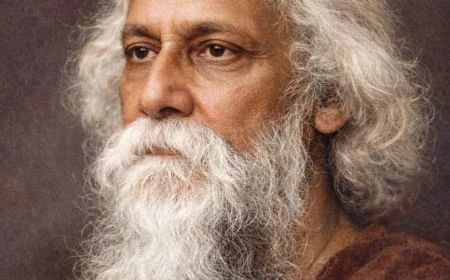




Rabindranath Tagore
A detailed biography of Rabindranath Tagore covering his early life, education, literary career, major contributions, awards, and lasting legacy.

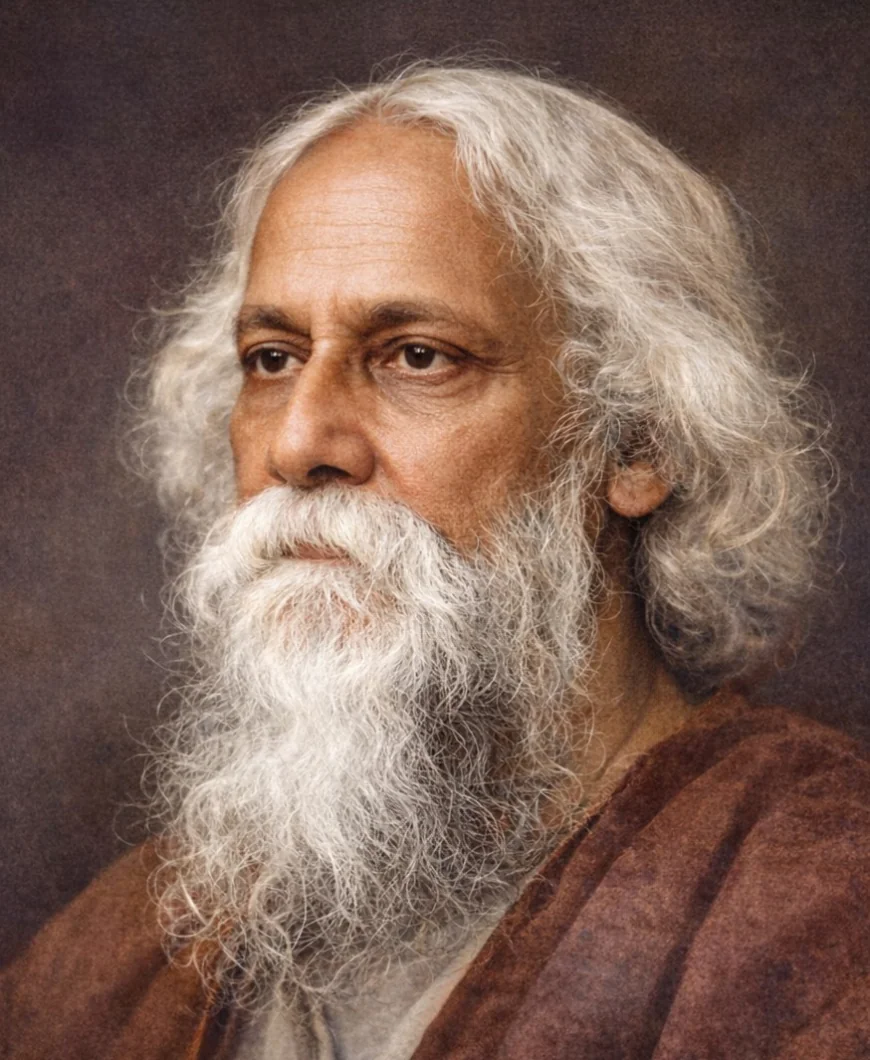
Rabindranath Tagore
Introduction
Rabindranath Tagore was an Indian poet, writer, philosopher, composer, and educationist who played a central role in shaping modern Bengali literature and culture. He was the first Asian to receive the Nobel Prize in Literature and remains one of the most influential literary figures in world history.
Early Life and Background
Rabindranath Tagore was born on 7 May 1861 in Jorasanko, Calcutta, into a prominent and culturally rich family. His father, Debendranath Tagore, was a leading philosopher and reformer associated with the Brahmo Samaj. From an early age, Tagore was surrounded by literature, music, art, and intellectual discussions, which deeply influenced his creative development.
Unlike many of his contemporaries, Tagore disliked rigid classroom education and preferred independent learning. His early exposure to classical Indian traditions as well as Western literature helped shape his broad and universal outlook.
Education
Tagore received most of his education at home under private tutors. He briefly attended institutions such as the Oriental Seminary and Presidency College but never completed formal academic degrees.
In 1878, he traveled to England to study law. However, he soon realized that academic law studies did not align with his interests and returned to India. Despite the absence of institutional qualifications, Tagore became one of the most learned intellectuals of his time through self-study and creative exploration.
Literary Career and Achievements
Rabindranath Tagore began writing poetry at a young age and went on to create an extraordinary body of work that includes poems, novels, short stories, plays, essays, and songs. His writings addressed themes such as humanism, spirituality, love, nature, nationalism, and social reform.
Some of his most renowned literary works include Gitanjali, Gora, The Home and the World, Chokher Bali, and Kabuliwala. His poetry collection Gitanjali, translated into English by Tagore himself, earned him the Nobel Prize in Literature in 1913, making him the first non-European laureate.
Major Contributions
Tagore revolutionized Bengali literature by introducing new literary forms and modern themes. He composed over two thousand songs, collectively known as Rabindra Sangeet, which continue to shape Bengali music and culture.
In the field of education, Tagore founded an experimental school at Santiniketan in 1901, which later developed into Visva-Bharati University. His educational philosophy emphasized creativity, freedom of thought, and learning in harmony with nature.
Tagore also made a lasting national impact by writing the national anthems of India (“Jana Gana Mana”) and Bangladesh (“Amar Sonar Bangla”).
Awards and Honors
Nobel Prize in Literature (1913)
Knighted by the British Crown (later renounced in 1919)
Honorary degrees from universities across Europe, Asia, and the Americas
International recognition as a global literary and cultural icon
Personal Life
Rabindranath Tagore married Mrinalini Devi, and they had several children. His personal life was marked by deep emotional experiences, including the loss of his wife and children, which profoundly influenced his writings.
He believed strongly in universal human values, cultural harmony, and the unity of mankind. These ideals were consistently reflected in both his literary works and public speeches.
Legacy
Rabindranath Tagore’s influence extends far beyond literature. His contributions to education, music, art, and philosophy continue to inspire generations worldwide. He is remembered as a symbol of intellectual freedom, cultural renaissance, and universal humanism.
What's Your Reaction?
 Like
0
Like
0
 Dislike
0
Dislike
0
 Love
0
Love
0
 Funny
0
Funny
0
 Angry
0
Angry
0
 Sad
0
Sad
0
 Wow
0
Wow
0